Ask a data leader whether their organization’s data is AI-ready, and the honest answer is usually “some of it, for some things.” That is the right answer. AI readiness describes data in relation to a specific use case. A customer dataset can be ready for a marketing segmentation model and nowhere near ready for an agent that updates customer records.
Guessing wrong is expensive. Gartner predicts that, through 2026, organizations would abandon 60% of AI projects unsupported by AI-ready data. Its advice to data leaders is blunt: “if the data has issues, then the data is not ready for AI.”
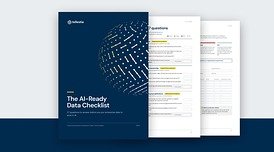
This is the checklist Tellestia’s data and integration teams use when clients ask us to assess an AI use case before build. Work through it for one use case at a time, with both business and IT owners in the room.
What Is AI-Ready Data?
AI-ready data is data that is fit for a defined AI use case: relevant, representative of that use case, accurate enough, current enough, clearly defined, traceable to its source and accessible under the right controls. It differs from BI-ready data in one important way. Reports are read by people, who notice when numbers look wrong. AI models and agents act on data directly and at scale, so problems a person would catch can pass straight through.
AI readiness is also not a one-time certification. Data changes, business context changes, and the patterns a model needs to handle can change too. Gartner emphasizes that AI-ready data requires ongoing testing and monitoring, not a single cleanup project.
The AI-Ready Data Checklist: 9 Areas to Assess
Each area has three questions. Answer them with evidence, not opinion: a profiling report, a named owner, an approved access policy. If nobody in the room can produce the evidence, treat the answer as no.
- Use Case and Scope
- Is there one clearly defined use case, with a named business owner and a measurable outcome?
- Have you listed the decisions or actions the AI will make or support?
- Do you know the cost of a wrong answer or a wrong action?
- Data Inventory and Ownership
- Have you mapped every system, table, API and document set the use case depends on?
- Does each source have a named owner who can approve its use for AI?
- Are there sources you need but cannot currently access?
- Master Data and Shared Definitions
- Are the core entities in scope, such as customer, product or supplier, defined the same way across systems?
- Is there a golden record, or a clear system of record, for each of them?
- Is there a business glossary that both the AI and its users can rely on?
- Measurable Data Quality
- Have you set thresholds for completeness, accuracy, duplication and validity for this use case?
- Have you profiled real production data, not a cleaned extract?
- Is there a process for fixing quality issues at the source, not only in the pipeline?
- Integration and Data Freshness
- Do you know how current the data must be: daily, hourly or real time?
- Do your integration patterns match that need, using APIs, events or change data capture where batch is too slow?
- Are the pipelines feeding AI production-grade, with error handling, retries and alerting?
- Metadata, Lineage and Context
- Can you trace any AI output back to the source records behind it?
- Are fields described well enough that a model, or a new analyst, would interpret them correctly?
- Is metadata kept current automatically, not in a spreadsheet updated once a year?
- Security, Privacy and Access
- Has personal and sensitive data been identified and classified?
- Will the AI reach data through governed APIs, using each user’s identity and permissions?
- Have legal, privacy and compliance teams approved this data for this purpose?
- Unstructured Content Readiness
- Does every document collection used for retrieval have an owner and a single current version?
- Have outdated policies, contracts and manuals been removed from the retrieval index?
- Do document permissions carry through to what the AI can retrieve for each user?
- Monitoring After Go-Live
- Are volume, schema, freshness and distribution changes monitored on the data feeding the AI?
- Is there an owner and an escalation path when data alerts fire?
- Will you review model or agent outputs regularly for signs of data drift?
How to Score Your AI Data Readiness
Score each of the nine areas green, amber or red. Green means every question has a confident yes, backed by evidence. Amber means the gaps are known and there is a plan to close them. Red means one or more questions cannot be answered at all.
Our rule of thumb: do not start a build with a red in area 2, 3 or 7. In our experience, missing ownership, conflicting master data and ungoverned access are among the issues most likely to stall a project at security review or after launch. Ambers elsewhere can usually be closed during delivery, as long as each one has an owner and a date.
Common Mistakes When Preparing Data for AI
- Trying to make all enterprise data AI-ready first. That program never finishes. Scope readiness to the use case in front of you.
- Fixing data only inside the AI pipeline. If the source stays wrong, the problem returns with every load.
- Treating the pilot extract as proof. Readiness has to be tested on live production data.
- Expecting the AI platform to fix it. Vector stores and model platforms consume data. They do not resolve ownership, definitions or permissions.
- Leaving the integration team out. Freshness, access and lineage all depend on the integration layer, so the people who run it belong in the assessment.
Download the AI-Ready Data Checklist Excel Scorecard
AI-Ready Data FAQs
What makes data AI-ready?
Data is AI-ready when it is relevant to a defined use case, representative of that use case, meets agreed quality and freshness thresholds, uses consistent definitions, can be traced to its source and is accessible under proper governance.
How long does it take to get data AI-ready?
It depends on the use case and the gaps the assessment finds. There is no fixed timeline. Scoping readiness to one use case keeps the work bounded and lets teams deliver value while broader data management matures. AI readiness should also be treated as an ongoing practice, not a one-time certification.
Who should own AI data readiness?
Business data owners are responsible for definitions and quality. IT and integration teams are responsible for pipelines, access and monitoring. A data or AI governance group should own the checklist itself and approve each use case before build.
Shyam Sundar
Technical Architect
Shyam Sundar is a Technical Architect at Tellestia, with a deep passion for building scalable and future-ready tech solutions. He shares insights on architecture, engineering best practices, and emerging technologies.
AI-Ready Data
Data Governance
Data Integration
Master Data Management