Key takeaways
- Gartner predicts that through 2026, organizations will abandon 60% of AI projects unsupported by AI-ready data.
- Most AI pilots succeed on a curated extract and struggle when they meet live, messy, multi-system data.
- Six data layer failures account for most stalled projects: stale data, conflicting definitions, missing lineage, unsafe access, unmanaged documents and no monitoring.
- Agentic AI raises the stakes, because bad data now produces wrong actions as well as wrong answers.
The demo went well. The model answered questions about customers, flagged churn risks with impressive accuracy, and the steering committee approved the budget for production. Six months later, the project is paused. Nothing changed in the model. What changed was the data it had to work with.
This pattern is now common enough to have numbers attached. In February 2025, Gartner predicted that through 2026, organizations will abandon 60% of AI projects unsupported by AI-ready data. In the same release, Gartner reported that a July 2024 survey of 1,203 data management leaders found that 63% of organizations either do not have the right data management practices for AI or are unsure whether they have them.
At Tellestia, most of our work happens underneath enterprise applications, in the APIs, integrations and data flows that connect them. When an AI initiative stalls, that is usually where we find the cause.
The Pilot-to-Production Gap Is a Data Problem
AI pilots are built in favorable conditions. A data scientist pulls an extract, cleans it by hand, removes the obvious duplicates and works against a static dataset. The results look excellent because the hardest work was done manually, once.
Production takes every one of those conditions away. Data arrives continuously from many systems, nobody cleans it by hand, and the model or agent now depends on integrations, permissions and definitions the pilot never tested. Data that is good enough for a monthly dashboard is often nowhere near good enough for a system that makes or recommends decisions in real time.
Six Data Layer Failures That Stall Enterprise AI
- The Model Learned From a Snapshot, but Production Runs on a Stream
The pilot used last quarter’s data. Production needs today’s. If inventory, pricing or customer status reach the AI through nightly batch jobs, an assistant will confidently quote yesterday’s answer. Freshness needs to be defined for each use case, then met with the right integration pattern, whether that is APIs, events or change data captur
- Three Systems, Three Definitions of “Customer”
The CRM counts accounts, the ERP counts bill-to entities and the support platform counts contacts. Ask an AI model how many active customers you have, and it will pick one definition or, worse, blend all three. Without master data management and shared business definitions, AI inherits every inconsistency in your systems and presents it with confidence.
- Nobody Can Say Where the Answer Came From
When a regulator, an auditor or a sales director challenges an AI output, someone has to trace it back to the source records. Without metadata and lineage, that trace is impossible, and one unexplained answer can be enough to lose business trust in the whole system.
- The Data Exists, but the AI Cannot Reach It Safely
Valuable data often sits in on-premises ERPs, mainframes or partner systems with no governed API. Teams then take shortcuts: shared service accounts, broad database credentials or bulk exports into the AI platform. Each shortcut creates a security and privacy exposure, and many projects stop at the security review. Access should run through governed APIs and integration flows, using identity and permissions that respect what each user is allowed to see.
- Documents Nobody Owns
Generative AI and retrieval-augmented generation (RAG) depend on unstructured content such as policies, contracts, manuals and knowledge articles. In most enterprises, these exist in several versions across SharePoint sites, shared drives and email. If the retrieval index holds the 2022 policy alongside the 2025 one, the assistant will eventually quote the wrong one. Unstructured content needs owners, version control and retirement rules, just like structured data.
- No One Watches the Data After Go-Live
Source systems change. A field gets repurposed, an integration starts failing silently, a supplier changes a file format. Traditional data quality checks run occasionally. AI systems need continuous data observability, with alerts on volume, schema, freshness and distribution changes, so problems are caught before users notice the answers getting worse.
Why Agentic AI Raises the Stakes
Every failure above becomes more serious as enterprises move from AI that answers questions to AI agents that take actions. A chatbot working from stale data gives a wrong answer that a person can ignore. An agent working from the same data can issue a refund, change a supplier record or reorder stock. Agents also call several systems in sequence, so one bad record can spread through an entire workflow before anyone reviews it.
That is why we treat the data and integration layer as part of an agent’s safety model. The connectors, credentials and validation rules an agent relies on decide how much it can get wrong.
How to Fix the Data Layer Before Your Next AI Project
Gartner emphasizes that AI-ready data must be defined for each use case. In Tellestia’s delivery work, five practical steps make the biggest difference:
- Anchor on one use case. Map every data source, entity and document it depends on before choosing a model.
- Master the entities that matter. Agree definitions and establish a golden record for the core entities in scope, usually customer, product or supplier.
- Build governed access paths. Expose data through managed APIs and integration flows, with user-level identity and least-privilege permissions.
- Set freshness and quality thresholds. Decide how current and complete the data must be, and test against those thresholds on live data before launch.
- Monitor continuously. Treat pipelines that feed AI as production systems, with observability, alerting and a named owner.
For a question-by-question version you can run with your own teams, see our AI-ready data checklist.
AI Project Failure FAQs
1. Why do most AI projects fail?
Most enterprise AI projects stall for reasons outside the model: data that is stale, inconsistent or hard to access safely, unclear business value, and weak governance. Gartner predicts that through 2026, organizations will abandon 60% of AI projects unsupported by AI-ready data.
2. What is the data layer in an AI project?
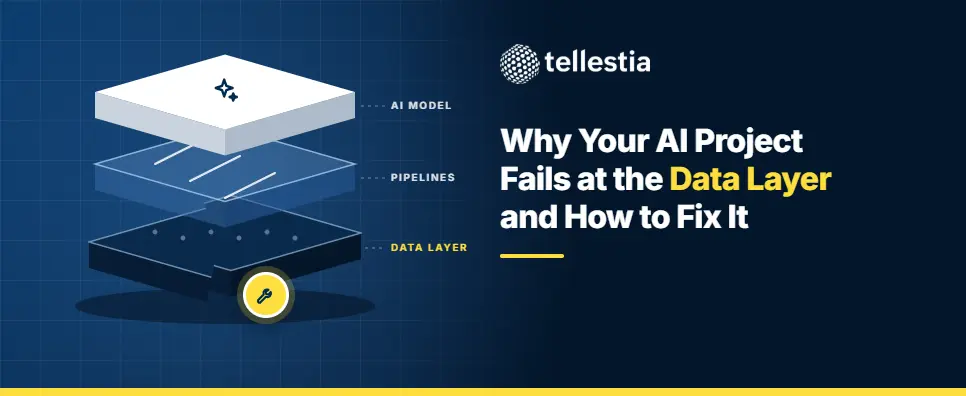
It is everything between your source systems and the AI model or agent: integrations, pipelines, APIs, master data, metadata, access controls and monitoring.
3. How is AI-ready data different from BI-ready data?
BI tolerates some delay and manual reconciliation because people interpret the results. AI systems act on data directly and at scale, so they need current, consistent, well-described and properly governed data for each specific use case.
A. Subramaniam
Chief Technology Officer
Agentic AI
AI-Ready Data
Data Governance
Data Integration
Master Data Management