Master Data Management vs Data Integration: What Your Enterprise Actually Needs
Master Data Management vs Data Integration: What Your Enterprise Actually Needs
Data Management
October 27, 2026
A sales rep updates a customer’s billing address in Salesforce. Finance still invoices the old address from the ERP, and support sees a third version on a duplicate account. The question that follows in most IT departments: do we need master data management, or just better integration?
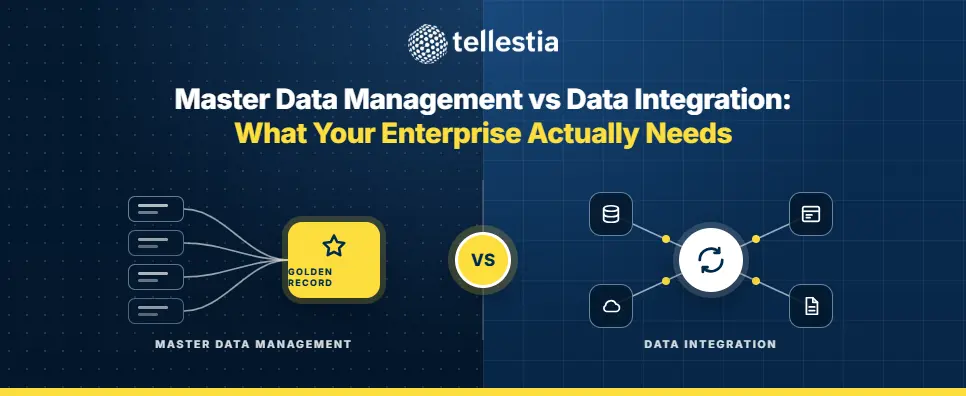
It is usually framed as a choice between two tools. It is really two different problems. Data integration gets data from one place to another. Master data management decides which data is right. Confuse the two, and you either buy an MDM hub to fix a pipeline issue, or build more pipelines that copy the wrong record into more places.
Data integration is the set of patterns and platforms that move and transform data between systems, so each one gets what it needs, in the right format, on time. It covers several styles:
Application integration. APIs, events and iPaaS flows that keep ERP, CRM and HR systems in step.
Analytical integration. ETL and ELT pipelines that load data into a warehouse or lakehouse for reporting and AI.
Change data capture (CDC). Streaming database changes so downstream systems stay current without full reloads.
Integration answers how a new order reaches the warehouse system, how quickly, and what happens if the target is down. It does not answer whether the customer on that order already exists under a slightly different name.
What Is Master Data Management?
Master data management (MDM) combines process, governance and technology to create and maintain one trusted version of your core business entities, often called the golden record. Master data covers the nouns of the business: customers, products, suppliers, locations, employees and assets. Transactions such as orders and payments are not master data, although they all reference it.
An MDM capability typically includes:
Domain models with agreed definitions of what a customer or a product actually is.
Matching and merging, which recognizes that “ACME Ltd” and “Acme Limited” at the same address are one company.
Survivorship rules, which decide which source wins for each attribute. The ERP might own the billing address while the CRM owns the account manager.
Data stewardship, where named people resolve the exceptions that rules cannot.
MDM answers different questions: which record is true, who owns it, and how do we keep it true?
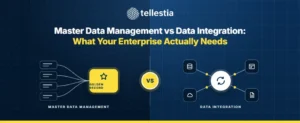
Master Data Management vs Data Integration, Side by Side
Data integration
Master data management
Core question
How does data get from A to B, on time and in the right shape?
Which version of this record is correct, and who decides?
Scope
Any data: transactions, events, files and master data
Fast, reliable delivery of duplicate or conflicting records
An accurate hub that downstream systems never use
Which One Does Your Enterprise Need? A Practical Test
Start with Data Integration If…
Each core entity is created and maintained in one system of record, and other systems only consume it.
Your pain is latency, manual re-keying or fragile point-to-point connections between a few applications.
Here, a well-designed integration layer gives you consistency without the cost of an MDM program.
You Need Master Data Management When…
The same entity is created or maintained in multiple systems, often three or more, such as customers entering through ecommerce, the CRM and a contact center.
Mergers have left you with parallel ERPs or CRMs and overlapping customer and supplier bases.
Audit, privacy or regulatory obligations require a single, traceable view of a customer or supplier.
You are launching AI or customer 360 initiatives that depend on one consistent view of each entity.
Most Enterprises Need Both, in the Right Order
For organizations with several core systems, the honest answer is both, and sequence matters. We usually recommend stabilizing the integration layer first, then introducing MDM for the one domain causing the most business pain, typically customer or product.
Why One Without the Other Fails
We regularly inherit programs that went wrong in one of two ways. In the first, a team builds a clean golden record in an MDM hub but never connects it back to the ERP or CRM. Users keep working in their own applications, and the hub becomes an accurate report that changes nothing.
In the second, every interface carries its own logic for deciding whether two customers match. Twenty interfaces later, there are twenty slightly different matching rules and no single place to fix them. The integration layer works perfectly. It just distributes the inconsistency faster.
MDM Implementation Styles and the Integration Each One Needs
How you implement MDM decides how much integration work it requires. The four common styles are:
Registry. The hub stores match links and pointers to source records, read on demand.
Consolidation. Data is copied into the hub for reporting, and sources are not updated. Integration runs one way.
Coexistence. The hub and sources both hold master data, and changes synchronize both ways. This requires robust, bidirectional synchronization, making integration design and operational monitoring critical.
Centralized. The hub becomes the system of entry, and every other application receives master data from it.
Many organizations choose coexistence for customer and supplier data, because it raises quality without forcing teams to change applications. That makes integration the part of an MDM program that decides whether it succeeds.
Bringing MDM and Data Integration Together on One Platform
Platforms that combine MDM and integration remove a seam you would otherwise manage yourself. Boomi Data Hub, for example, works with Boomi Integration to synchronize golden records in both directions between the hub and connected applications, using a hub-and-spoke model in place of point-to-point copies. Boomi has also extended its data movement capabilities by acquiring Rivery, adding ELT and change data capture (CDC) capabilities for analytics and AI workloads.
Whatever the platform, model one domain at a time, define survivorship rules per attribute, route every application through the hub for that domain, and monitor sync failures and stewardship queues as closely as uptime.
Is master data management a type of data integration?
No. MDM relies on integration to collect and distribute records, but its job is governance: deciding which version of an entity is correct.
Can an iPaaS replace an MDM tool?
An iPaaS can enforce simple rules, such as routing updates from a designated system of record. It is generally not a substitute for dedicated MDM capabilities such as probabilistic matching, survivorship rules, hierarchy management, and stewardship workflows at scale. Once the same entity is created in several systems, you need MDM capability.
Which data domain should we master first?
Start with the domain causing the most measurable business pain, usually customer or product, because errors there reach invoices and orders directly.
A. Subramaniam
Chief Technology Officer
Share Blog Via:
Boomi
Data Governance
Data Integration
Master Data Management
The AI-Ready Data Checklist: A Practical AI Data Readiness Assessment