WSO2 vs MuleSoft (2026): Which Integration Platform Fits Your Operating Model?
WSO2 vs MuleSoft (2026): Which Integration Platform Fits Your Operating Model?
WSO2, API Management
September 14, 2026
WSO2 and MuleSoft both do API management. Both do integration. Both handle transformation, security policy, monitoring, and lifecycle governance at enterprise scale. Both run in the cloud, on-premises, or in hybrid configurations. Build a capability matrix and most rows come back even.
The difference sits where a matrix cannot show it. MuleSoft sells you an operating model: a prescribed way to design, publish, govern, and reuse integrations, with the platform carrying the conventions. WSO2 gives you modular capabilities and expects you to compose the operating model that fits your architecture and governance needs.
Here is the uncomfortable part, and it applies to both camps. Many organizations that choose MuleSoft pay for conventions they could have defined internally, if they had the time and the mandate to do it. Many that choose WSO2 underestimate what composing an operating model costs in architecture time and platform operations. Both get the same trade wrong, in opposite directions.
That distinction drives everything else in a WSO2 vs MuleSoft evaluation, including the parts that look like separate topics. Cost structure, required skills, deployment flexibility, and time to standardized delivery all follow from it.
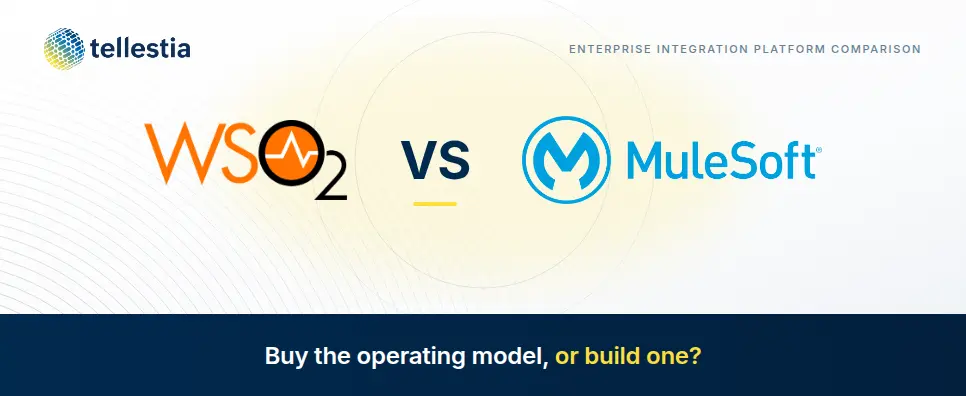
So the questions worth answering is not which platform has more capability. It is: do you want to buy an operating model, or compose one?
Salesforce is strategically central to your CRM, automation, and digital platform roadmap
You want an opinionated API-led connectivity model with governed reuse and a central integration function
Faster onboarding into a standardized vendor platform matters more than runtime-level customization
You can support the commercial investment and forecast capacity, including usage peaks, with reasonable confidence
You have access to MuleSoft-skilled developers, architects, and operations resources
What You Are Actually Comparing
WSO2 is a modular set of integration, API management, and identity products, including WSO2 API Manager, WSO2 Micro Integrator, and WSO2 Identity Server. Its open source distributions are released under Apache License 2.0, alongside paid support subscriptions and cloud offerings. You compose the architecture you need and operate it where you choose.
MuleSoft is Anypoint Platform, a commercial platform spanning API design, implementation, management, governance, monitoring, and asset reuse, with managed-cloud and hybrid runtime options. New customers buy MuleSoft Integration Starter or MuleSoft Integration Advanced, with an API Management Solution package available as a standalone entry point.
The Case for Buying the Operating Model
MuleSoft's real product is convention. API-led connectivity gives teams a shared vocabulary and a prescibed structure: build reusable APIs in defined layers, publish them to a governed marketplace, operate them from a consistent control plane.
For organizations without an established integration practice, that accelerates standardization considerably. Architecture debates that would otherwise run for a year arrive pre-settled. Governance is carries partly by tooling, which matters when the integration team owns the standards but has no authority over the teams building against them.
Tooling does not replace governance. Adoption, architecture leadership, and enforcement still have to come from somewhere. What it lowers is the activation energy, and for an organization starting from nothing that is a genuine advantage.
The same conventions become constraints when your architecture needs something outside them: non-standard gateway policies, custom token handling, or federation across multiple gateway runtimes. Worth testing early, because this is the objection that surfaces in month four of an implementation rather than during evaluation.
The broader trade is dependency. A commercial platform reduces assembly effort and increase product, licensing, and specialist-skill concentration. That is a sensible trade when the alternative is no standardization at all. It is a poor one when you already have the engineering capability to define your own conventions, because you are paying for structure you could have built and accepting constraints you did not need.
Where MuleSoft's case is strongest is Salesforce. One diagnostic settles it for most teams: is Salesforce the system of record for your customer data and the primary automation hub for your revenue processes? If yes, the alignment is strategic and you should weight it heavily. If Salesforce is one application among many, MuleSoft's other advantages have to justify the commercial and dependency profile on their own.
The Case for Composing Your Own
WSO2's advantage is control and composability, and its value scales with how constrained your environment is.
If regulatory or data residency requirements dictate where runtimes sit, if you are Kubernetes-first, if your security architecture requires custom gateway and policy patterns, or if you need integration and API governance alongside identity from one ecosystem, WSO2 is built for that. Apache 2.0 licensing on the open source distributions also changes the evaluation itself. You can prototype, customize, and run the open source runtime without a proprietary per-runtime barrier before making any commercial commitment.
Two things tend to matter most than teams expect. The first is gateway placement: where policy enforcement physically runs, and whether you can federate across several gateway deployments without routing everything through one vendor's control plane. The second is exit cost. Composability is worth something precisely because the parts are replaceable.
This matters most in regulated sectors. On a smart loan disbursement program for an East African bank, what settled the platform choice was deployment control and the ability to shape security architecture around local regulatory constraints. Throughput never entered the discussion.
The trade is accountability. Flexibility means nobody hands you conventions. You need architecture discipline, DevSecOps maturity, and platform operations capability, or a partner supplying them through a managed service. Adopt WSO2 without deciding who owns those responsibilities and you get flexibility you cannot use, plus a platform that eventually only two people in the building understand.
Why WSO2 vs MuleSoft Cost Comparisons Usually Go Wrong
The two platforms do not just cost different amounts. They cost in different shapes, which is why like-for-like quotes are harder to assemble here than in most platform comparisons.
MuleSoft moved new customers off the vCore model in March 2026. Today's packages, MuleSoft Integration Starter and MuleSoft Integration Advanced, are charged on subscription and measured by Mule Flow and Mule Message capacity, with API Management scoped and priced separately. Pricing is quote-based with no public list rates, and legacy customers may still sit on older terms, so confirm current packaging with MuleSoft directly. Premium connectors and managed messaging are the two line items that most often land outside the original model.
WSO2's cost is spread across cloud infrastructure, support subscriptions, platform operations, upgrade effort, environment parity, and engineering time. More of it sits under your control. More of it is also easy to leave out of a business case.
The comparison fails when teams model MuleSoft fully and WSO2 partially. Open source licensing is not the sames thing as low total cost. A defensible model includes, on the WSO2 side, everything listed about plus the engineering time to build conventions the commercial platform would have supplied. One the MuleSoft side it needs projected flows, messages, environments, API management scope, and support tier, sized against 3-5 year growth and not today's volume.
Model both at double your projected capacity. That is where the two shapes pull apart.
Modelling this now? We build 3-5 year cost models covering both cost shapes, using your projected volumes and not list pricing. Request a platform-fit assessment.
How to Test the Decision Properly
Feature matrices and analyst comparisons are inputs. A scored proof of value on two or three representative use cases will tell you considerably more.
Choose a real-time API integration with policy enforcement and developer onboarding, a hybrid or legacy integration involving secuirty, transformation, error handling, and monitoring, and an event-driven or high-volume workload if that is material to you.
Score both platforms on delivery effort, runtime performance, observability, deployment automation, security controls, developer experience, operational supportability, change cost, and multi-year total cost. Make two of those measurable rather than impressionistic: time to detect and triage a failed flow, and the effort to modify a working integration once requirements shift.
How Tellestia Approaches This
Tellestia combines WSO2-certified expertise with hands-on MuleSoft implementation, modernization, and managed-support experience across enterprise integration estates in banking, insurance, manufacturing, retail, and telecom.
We assess platform fit through architecture review, representative integration use cases, operating model design, and multi-year cost analysis. Our recommendation follows your architecture, operating model, and commercial constraints, and never on certifications alone.
That means we will tell you when MuleSoft is the better answer, and we do. Where Salesforce is strategically central, or where an organization needs standardized delivery conventions faster than it can realistically build them, the case is usually clear. We have also moved teams onto WSO2 across deployment control, cost structure, or hybrid architecture requirements and managed a commercial platform entirely.
Get a Platform-Fit Assessment, Not a Vendor Pitch
If you are shortlisting or reconsidering an existing platform, you get four things you can act on:
A platform-fit scorecard against your architecture, deployement constraints, and operating model
A 3-5 year TCO model covering both cost shapes
A deployment and architecture recommendation
A scoped proof of value on two of your real use cases
You retain the output and can use it for internal decision-making, procurement, or a proof of value regardless of the final platform decision.
Request a platform-fit assessment. Share your deployment model, major systems, Salesforce footprint, and expected integration volume, and we will come back with a view on which platform we would put our name behind.
Frequently Asked Questions
Is WSO2 better than MuleSoft?
WSO2 fits organizations needing deployment control, hybrid or Kubernetes-first architecture, and cost tied to infrastructure they own. MuleSoft fits organizations wanting a standardized API-led delivery model, governed reuse, and close Salesforce alignment. What decides it is whether you want to buy an operating model or compose one.
Is WSO2 free?
Yes, WSO2's open source distributions are released under Apache License 2.0, so there is no proprietary licence barrier to evaluating or running the open source runtime. That is not the same as free, and it is separate from WSO2's paid support subscriptions, cloud, and enterprise offerings.
Is WSO2 a credible MuleSoft alternative for enterprise API management?
Yes. Both are credible enterprise API management platforms. MuleSoft is stronger for centralized lifecycle governance and business-led reuse. WSO2 is stronger where you need gateway deployment flexibility, custom security architecture, and closer infrastructure ownership.
How do WSO2 and MuleSoft pricing compare?
They are not directly comparable. MuleSoft is quote-based, with new customers on Integration Starter or Integration Advanced packages measured by Mule Flow and Mule Message capacity, and API Management priced separately. WSO2 cost is spread across infrastructure, support subscriptions, and engineering effort. Build a multi-year model covering both cost shapes, and confirm current packaging with each vendor.
Does choosing MuleSoft make sense without Salesforce?
It can, where standardized delivery conventions and governed API reuse are the top priority and the budget supports it. But Salesforce alignment is MuleSoft's clearest strategic differentiator, and an evaluation that does not weigh it should ask hard whether the platform's other advantages justify its commercial and dependency profile on their own.
A. Subramaniam
Chief Technology Officer
Share Blog Via:
API Governance
Enterprise Integration
MuleSoft
MuleSoft Alernative
Open source integration
Platform selection
Salesforce Integration
trending
WSO2
Wso2 API manager
Related Blogs
WSO2
October 19, 2026
WSO2 Integrator 5.0 Tutorial: Build a Validated Order API the Production Way
What WSO2 Integrator 5.0 changes for integration teams, and a hands-on build of a validated...