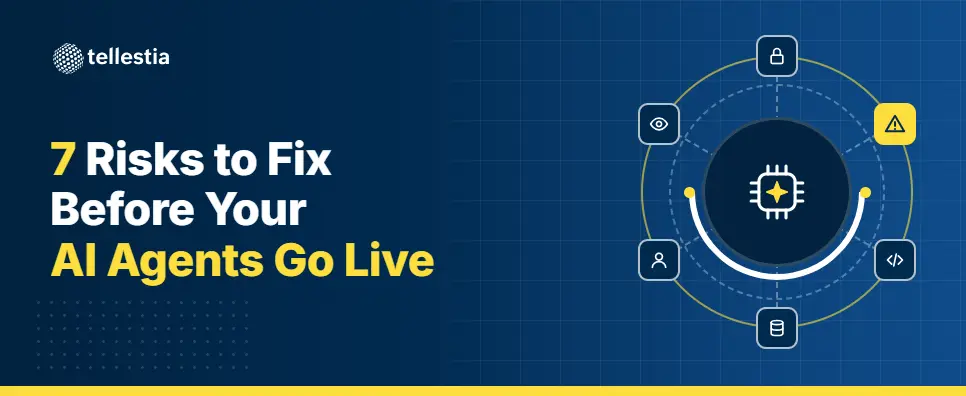
AI Agent Integration: 7 Risks to Fix Before Your Pilot
AI Agent Integration: 7 Risks to Fix Before Your Pilot
Enterprise Integration
November 6, 2026
The board has seen the demos. Leadership wants AI agents approving invoices, updating CRM records and answering customer queries by next quarter. And the question lands on your desk: can our systems actually handle this?
Most of the conversation so far has been about models and prompts. The harder question sits one layer down. AI agent integration is where an agent stops talking and starts doing. Every useful agent action, from reading a policy record to raising a purchase order, travels through your APIs, your identity provider and your middleware.
That layer was built for people and predictable applications. It was not built for software that decides on its own which system to call next. This guide walks through seven integration risks to check before you give AI agents access to enterprise systems. Each one comes with a short self-diagnostic you can run with your team this week, followed by a practical plan to close the gaps before your first pilot.
Traditional integrations follow a script. A developer decides which API gets called, in what order, with what data. Security teams review that flow once, and it behaves the same way every day after.
AI agents in enterprise systems work differently. They choose their own path at runtime. One request might trigger two API calls; a similar request might trigger twelve, across systems nobody mapped together. They also act on content they read, which means a cleverly worded email or document can steer what they do next.
Three assumptions quietly fall apart:
Known callers. Your integration layer expects a named application or a logged-in human. An agent is neither.
Predictable volume. An agent stuck in a retry loop can hit an API thousands of times in minutes.
Reviewed paths. You cannot sign off a flow that is decided on the fly, so the controls have to live in the platform instead.
That shift is the heart of agent integration readiness. The seven risks below show where it usually breaks.
7 AI Agent Integration Risks to Check Before You Go Live
Run each self-check with your platform, security and data owners in the room. If you answer "no" or "not sure" to more than one question in a risk, treat it as a gap to close before the pilot.
1. Agents Borrowing Human Credentials
The fastest way to get an agent working is to hand it a developer's token or a shared service account. It is also the fastest way to lose control. When something goes wrong, every log says a person did it, and you cannot revoke the agent without breaking everything else that uses that account.
Self-check:
Does each agent have its own non-human identity in your identity provider?
Are its tokens short-lived and scoped, rather than long-lived API keys?
When an agent acts for a user, does the downstream system know both who asked and which agent acted?
What good looks like: every agent is registered like an application, authenticates with OAuth client credentials or a workload identity, and uses delegated (on-behalf-of) tokens when acting for a user.
Many enterprise APIs offer two settings: read-only or everything. Agents end up with far more access than the task needs because nobody wants the pilot blocked on a permissions ticket.
Self-check:
Can you grant an agent access to one action (for example, "create draft order") without granting "manage orders"?
Is there a named owner who approves each agent's scope?
Do you review and expire agent permissions on a schedule?
What good looks like: least-privilege scopes per agent and per task, approved by the system owner, with access reviews built into your IAM process.
3. Data Access With No Guardrails
Agents are hungry readers. A retrieval step that pulls "all relevant customer records" can bypass the row-level and field-level rules your applications enforce, and pass personal or regulated data straight into a model prompt. This is where AI integration governance matters most.
Self-check:
Is your data classified, so you know which fields are sensitive, regulated or region-bound?
Do agents read data through the same governed APIs as applications, not through direct database access?
Can you mask or filter sensitive fields before they reach the model?
What good looks like: agents consume data only through governed interfaces that apply masking, residency and consent rules automatically.
4. Too Many Tools, Too Much Exposure
Whether you use MCP servers, function calling or a vendor's agent framework, every tool you expose is a door. Teams often wrap entire internal APIs, including delete and bulk-update endpoints, because it is quicker than designing a narrow tool.
Self-check:
Do you keep a catalogue of every tool and API each agent can call?
Are destructive or financial actions separated from read actions, with extra approval?
Is the content an agent reads (emails, tickets, documents) treated as untrusted input that cannot trigger actions on its own?
What good looks like: a small, purpose-built set of tools per agent, published through your API gateway, with high-risk actions behind a human approval step.
Agents rely on API descriptions to decide what to call and how. Vague names, missing schemas and inconsistent error messages lead to wrong calls, repeated retries and quietly bad data.
Self-check:
Are your key APIs documented with complete OpenAPI specs, including clear descriptions of each field?
Do write operations support idempotency, so a retried call does not create a duplicate invoice?
Do errors return clear, consistent messages an agent can act on?
What good looks like: well-described, versioned APIs with predictable errors and safe retries, managed through a proper API management layer.
6. Agent Activity You Cannot See
If an agent updates 400 customer records overnight, can you tell which agent did it, why, and which user request started it? Most monitoring stacks track system health, not agent decisions. That gap turns every incident into guesswork.
Self-check:
Can you trace a single agent request end to end across every API and system it touched?
Are agent actions logged in a way auditors and compliance teams can review?
Do you get alerts on unusual agent behaviour, not only on system errors?
What good looks like: correlation IDs carried through every call, agent-aware dashboards and an audit trail that links each action to an agent, a user and a request.
7. No Brakes When an Agent Misbehaves
Agents fail in new ways: loops, runaway costs, confident mistakes at scale. Without limits, one faulty prompt can flood a legacy system or rack up thousands of dollars in API charges before anyone notices.
Self-check:
Are there rate limits and spending caps per agent, not just per application?
Can you switch off a single agent instantly without affecting other integrations?
Can multi-step actions be rolled back or compensated if a later step fails?
What good looks like: per-agent throttling at the gateway, a tested kill switch and compensation logic for transactions that span systems.
How to Close the Gaps Before Your AI Agent Pilot
You do not need to fix everything before the first agent goes live. You need to fix enough to run a safe, contained pilot and learn from it. A practical sequence:
Pick one use case with a clear boundary. Choose a process that touches two or three systems, has a measurable outcome and can tolerate a human review step. Claims triage or invoice matching work better than "an agent for the whole finance team".
Map every system and API the agent will touch. List each endpoint, the data it returns, its owner and its risk level. This map becomes your tool catalogue and your approval checklist.
Register the agent as an identity. Create a dedicated non-human identity, issue short-lived scoped tokens and set up delegated access if it acts for users.
Publish narrow tools through your API gateway. Wrap only the actions the use case needs. Add rate limits, spending caps and approval gates for any write or financial action.
Put governance in the data path. Apply masking, classification and residency rules at the API layer so the agent never sees what it should not.
Switch on tracing before the first call. Correlation IDs, agent-aware logs and alerts should be live on day one, not added after the first incident.
Rehearse failure. Test the kill switch, a retry storm and a prompt injection attempt in a non-production environment.
Set exit criteria. Agree up front what accuracy, cost and incident thresholds decide whether the pilot scales, changes or stops.
When the integration platform is already in good shape, this is weeks of work, not quarters. When it is not, these steps double as a modernisation roadmap.
What "Agent-Ready" Really Means for Your Integration Layer
Agent-ready does not mean you have bought an agent platform. It means your integration layer can tell who an agent is, limit what it can do, govern what it can see, and show you everything it did. The model is the easy part to swap. The integration layer is what you live with.
Area
Not ready
Agent-ready
Identity
Shared service accounts, borrowed user tokens
One non-human identity per agent, short-lived tokens
Permissions
Broad read or admin access
Least-privilege scopes per task, owner-approved
Data
Direct database reads, no masking
Governed APIs with masking and residency rules
Tools
Whole internal APIs exposed
Narrow, catalogued tools with approval gates
API quality
Thin docs, unsafe retries
Complete specs, idempotent writes, clear errors
Monitoring
System health only
End-to-end tracing and an auditable action log
Controls
No per-agent limits
Rate limits, spend caps, tested kill switch
If most of your answers sit in the middle column, that is normal. Very few enterprises built their integration estate with autonomous software in mind. What matters is knowing where the gaps are before an agent finds them for you.
FAQ: AI Agent Integration
1. What is AI agent integration?
AI agent integration is how an AI agent connects to enterprise systems such as ERP, CRM and core platforms so it can read data and take actions. It covers identity, API access, data governance, monitoring and controls.
2. Why can't AI agents use existing service accounts?
Shared accounts hide which agent did what, usually carry too much access and cannot be revoked without breaking other integrations. Each agent needs its own non-human identity with scoped, short-lived credentials.
3. What is AI integration governance?
It is the set of rules that decide which systems and data an agent can reach, under whose authority, and how every action is recorded. Good governance lives in the integration layer, not in the prompt.
4. How long does it take to become agent-ready?
It depends on the state of your APIs, identity setup and monitoring. A focused readiness assessment shows the gaps and gives a realistic timeline for your first pilot.
Shyam Sundar
Technical Architect
Share Blog Via:
Shyam Sundar is a Technical Architect at Tellestia, with a deep passion for building scalable and future-ready tech solutions. He shares insights on architecture, engineering best practices, and emerging technologies.
AI Agent Integration
AI Agent Security
AI Integration Governance
API Management
Enterprise Integration
The AI-Ready Data Checklist: A Practical AI Data Readiness Assessment