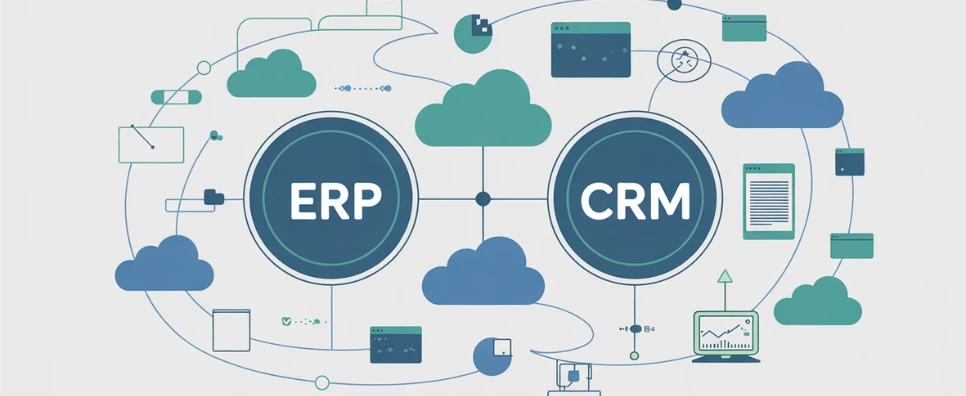
When your enterprise operates with siloed ERP and CRM systems, you’re not just dealing with a technical problem—you’re facing a silent revenue drain. According to research, companies lose between 20-30% of their revenue annually due to inefficiencies caused by data silos, while the financial cost of poor data quality alone reaches an average of $12.9 million per year for most organizations.
The complexity of connecting ERP and CRM systems goes far beyond flipping a switch. It requires understanding the nuanced business logic that drives each system, mapping data fields accurately, managing real-time synchronization across hybrid environments, and maintaining governance throughout the integration lifecycle. This is where enterprise integration expertise becomes invaluable—and where Boomi, a next-generation iPaaS platform, delivers transformative solutions that turn integration challenges into competitive advantages.
The Hidden Costs of Siloed ERP and CRM Systems
Before diving into solutions, let's examine what happens when ERP and CRM systems operate in isolation. The consequences extend far deeper than most organizations initially realize.
Data Fragmentation and Its Ripple Effects
Your sales team closes a $500,000 deal in Salesforce, capturing all the intricate customer requirements and custom specifications. Meanwhile, your finance department sits in the ERP, unaware of the deal structure, payment terms, or fulfillment obligations. The operations team, working from yet another data source, forecasts demand incorrectly because they're missing crucial information about what's actually been sold. By the time data manually trickles between systems—or worse, when someone manually re-enters it into a spreadsheet—the information is already stale and prone to errors.
This fragmentation creates what industry leaders call "multiple versions of truth." Sales sees a customer as highly engaged and profitable. Finance sees the same customer as 60 days past due. Marketing built a customer segmentation analysis based on one dataset, while operations built demand forecasts on another. These disconnected perspectives don't just create redundancy—they create conflicting strategies that cancel each other out, resulting in zero organizational momentum around the same customer.
The Productivity Black Hole
We've observed that teams without integrated systems spend an astonishing amount of time hunting for information. A sales manager spends Tuesday morning recreating a customer profitability analysis that the finance department already completed last week—and stored in their own system. A customer success manager searches across three platforms to answer a simple question: "What was this customer charged for last month?" These seemingly innocent information hunts, multiplied across an organization of hundreds of employees, represent millions in lost productivity annually.
When your teams lack visibility into complete customer data, they can't make proactive decisions. Cross-functional collaboration becomes impossible because there's no shared source of truth. Strategic initiatives that require alignment between sales, operations, and finance become exercises in frustration rather than execution.
The Compliance and Governance Nightmare
In BFSI and regulated industries, data silos create compliance risks. When customer information exists in multiple systems with different update frequencies, you face audit challenges. When order data flows differently through sales versus finance systems, reconciliation becomes manual and error-prone. When you can't track data lineage across your integration landscape, demonstrating compliance to regulators becomes extraordinarily difficult.
Why Traditional Integration Approaches Fall Short
Many organizations attempt to solve ERP-CRM integration challenges with custom coding, point-to-point integrations, or overly complex Enterprise Service Bus (ESB) solutions. These approaches consistently underdeliver because they:
- Require specialized, expensive talent: Traditional integration demands deep expertise in specific programming languages and integration patterns. When that specialist leaves, the organization loses institutional knowledge.
- Create maintenance nightmares: Custom code integrations become brittle and difficult to modify. Any change to either system requires expensive rework. As systems evolve, integrations break, and the organization becomes trapped in a cycle of firefighting.
- Don't scale with business agility: By the time a custom integration is deployed, your business requirements have often changed. You can't modify workflows quickly. You can't respond to market demands with speed.
- Lack governance and visibility: When integrations are custom-coded, there's no centralized monitoring, no clear audit trails, and no way to understand what data is flowing where. This is a compliance officer's nightmare.
- Can't handle hybrid environments effectively: Many organizations run systems across cloud and on-premises environments. Traditional point-to-point integrations struggle with this hybrid reality, requiring separate integrations for each combination.
This is where Boomi Integration Platform as a Service (iPaaS) fundamentally changes the game. Rather than treating integration as a specialized IT problem requiring months of development, Boomi democratizes integration through intelligent, visual, low-code design that any skilled business technologist can build and maintain.
Unified Data Visibility through Real-Time Synchronization
Boomi solves the data silo problem at its core by enabling true real-time synchronization between ERP and CRM systems. Unlike batch processing approaches that create lag between systems, Boomi's event-driven integration architecture ensures that when a customer record updates in your CRM, that change immediately reflects in your ERP—and vice versa. Sales teams see accurate inventory availability in real-time. Finance sees order information the moment sales commits to it. Operations forecasts demand based on live deal data, not historical snapshots.
This capability is built into Boomi's core architecture. The platform includes Boomi Event Streams for creating real-time, event-driven integrations, and Boomi Atom for distributed processing at the edge. These capabilities enable organizations to move beyond the batch mindset entirely, creating integrated systems that operate with true operational synchronization.
Drag-and-Drop Simplicity without Compromising Power
One of Boomi's defining characteristics is its low-code visual interface. Rather than requiring developers to write extensive code for data mapping and transformations, Boomi provides a drag-and-drop mapping interface that makes integration accessible to a broader set of practitioners. Pre-built connectors to over 200 leading applications – including Salesforce, SAP, Oracle, Microsoft Dynamics, and virtually every major ERP and CRM platform – eliminate the need to build connectors from scratch.
This matters more than it initially appears. It means integration projects move from months to weeks. It means when business requirements change - as they inevitably do - your integration team can modify workflows rapidly rather than submitting change requests to a specialist programmer. It means knowledge about your integration architecture isn't trapped with a single individual; it's visible and modifiable by any member of your integration team
Master Data Management and Data Governance at Scale
Boomi doesn't just move data between systems; it intelligently manages the quality and consistency of that data through Boomi Master Data Hub. When you're synchronizing customer records between CRM and ERP, data governance becomes critical. Customer information in your CRM might be slightly different from customer information in your ERP (different address formats, customer ID inconsistencies, contact name variations). Without proper master data management, these discrepancies corrupt your integrated data landscape.
Boomi Master Data Hub creates a single source of truth for critical data entities like customers, products, and vendors. It reconciles differences across systems, applies data quality rules, and ensures that whichever system needs that data, it gets a consistent, validated version. This eliminates the duplicate data entry, reduces reconciliation time, and ensures that your integration doesn't simply perpetuate existing data quality problems - it actively improves them.
Hybrid Cloud and On-Premises Flexibility
Many enterprises maintain a mix of cloud and on-premises systems. Your CRM might be in Salesforce while your ERP runs on-premises. Boomi's architecture was built for exactly this reality. Boomi Atom, a lightweight, containerized runtime engine, can be deployed anywhere: in your data center, in the cloud, at edge locations. The integration logic remains the same regardless of where the Atom executes. This gives organizations unprecedented flexibility in managing their hybrid integration landscape.
This architecture also means you avoid vendor lock-in. Whether your systems run on AWS, Azure, Google Cloud, or your own infrastructure, Boomi integrations work seamlessly. Your integration strategy isn't held hostage to any single cloud provider's roadmap.
API-First Architecture for Modern Application Ecosystems
Modern enterprises don't just need to integrate ERP and CRM. They need to expose that integrated data to modern applications, mobile interfaces, partner ecosystems, and emerging technologies like artificial intelligence. Boomi's comprehensive API Management capabilities enable you to publish, govern, and monetize APIs built on top of your integrated data.
Your integrated customer data becomes accessible through a managed API. Your supply chain visibility becomes an API. Your order-to-cash process becomes an API that partners can consume. This API-first approach future-proofs your integration investment while enabling new business models.
Centralized Governance, Monitoring, and Compliance
Boomi provides centralized visibility into your entire integration landscape. Rather than wondering what's flowing where, you can see every integration process, understand data lineage, monitor performance metrics, and identify bottlenecks. For regulated industries - particularly BFSI - Boomi's built-in governance and audit capabilities are invaluable. You can track who accessed what data, when, and for what purpose. You can enforce data governance policies across integrations. You can demonstrate compliance to auditors because you have complete visibility into your integration architecture.
The platform includes built-in monitoring dashboards with alerting, comprehensive logging, and analytics that enable your team to operate integrations proactively rather than reactively. When an integration slows down, your team knows before customers are impacted.
Tellestia brings deep, hands-on expertise in designing, implementing, and managing enterprise-grade Boomi integrations across BFSI, retail, telecom, and manufacturing.
Our strengths include:
- Certified Boomi professionals skilled in complex ERP–CRM integrations.
- Proven expertise in hybrid cloud environments.
- Strong domain knowledge in regulated industries.
- A consultative approach focused on process optimization—not just connectivity.
- Accelerators and reusable frameworks that reduce integration timelines.
We understand that ERP-CRM integration is not just a technical project - it impacts revenue operations, financial accuracy, customer experience, and compliance posture. Our engagement model ensures alignment with your business processes, governance frameworks, and long-term transformation goals.
Whether your challenge is data silos, long integration cycles, governance gaps, or hybrid complexity, Tellestia + Boomi provides a scalable and future-ready integration blueprint.
Let’s discuss how Tellestia can transform your ERP–CRM integration journey.
Contact us to explore integration success stories, solution architectures, and outcomes delivered for enterprises like yours.
A. Subramaniam
Chief Technology Officer
Boomi
Data Integration
ERP-CRM Integration
Hybrid Cloud
iPaaS
Master Data Management