AI Gateway vs API Gateway vs Agent Gateway: Why Enterprise AI Needs All Three
AI Gateway vs API Gateway vs Agent Gateway: Why Enterprise AI Needs All Three
API Management, API Trends
September 9, 2026
For about a decade, the API gateway was the good news story of enterprise architecture. One chokepoint. One place for authentication, routing, and rate limits. Whatever else was messy in your estate, traffic control was a solved problem.
Then AI traffic showed up and broke most of the assumptions that layer was built on.
REST traffic is predictable in shape and costs effectively nothing per call. AI traffic is neither. It’s priced per token, so one request can cost 400 times another. It streams rather than returning, which defeats caching and timeout logic designed for discrete payloads. It fans out across providers with different SLAs and different failure modes. And more and more often there’s no person or application on the other end at all. There’s an autonomous agent making a chain of decisions your gateway has no vocabulary to describe.
The market has already noticed. Gartner’s 2026 Hype Cycle for Platform Engineering puts the AI gateway on the map as its own category, separate from API management. Above it, a third layer is forming fast: the agent gateway, which governs not what a model says but what an agent actually does.
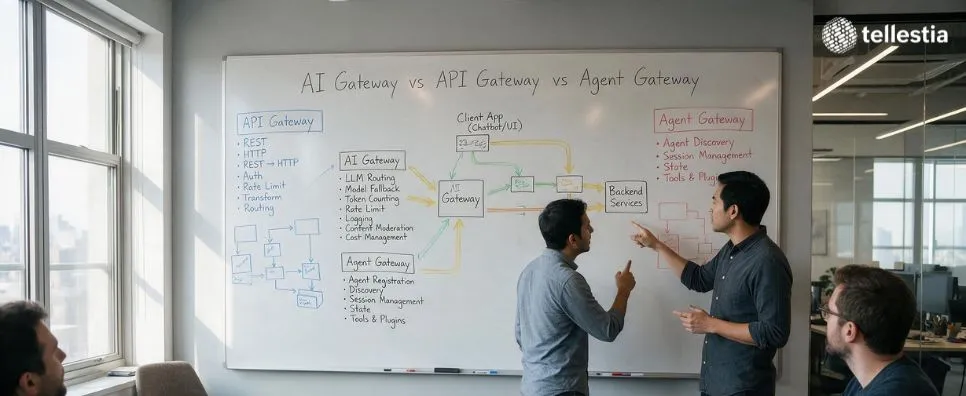
So here’s the real question for 2026. You’re going to end up with three control layers whether you plan for them or not. The only decision left is whether you design them as one governed control plane, or let them pile up until you’re running three policy engines, three identity models, three dashboards, and a governance story you can’t defend in an audit.
None of this is new. It’s the same failure mode that gave us point to point spaghetti in the ESB years, and the same one that turned early microservices estates into 400 undocumented endpoints. Integration debt never arrives as a decision. It arrives as a long run of individually reasonable ones.
Your API Gateway Was Built for Requests, Not Tokens
Your API management estate isn't going anywhere, and anyone selling you an AI gateway as a replacement for it is selling you a second silo. But its limits are worth naming precisely.
An API gateway counts requests, so it's blind to token economics. It mediates protocols, so it has no answer for streaming. It routes to healthy replicas, which is a genuinely different problem from failing over between two frontier models whose price, quality, and context windows all differ. It validates schema, so it can't catch prompt injection or PII leakage. Those are content problems rather than protocol problems, and a WAF rule doesn't see them.
The deepest gap is conceptual. As IBM puts it, API gateways were designed for humans and applications. Agent gateways are purpose built for autonomous actors with completely different security and observability needs.
What an AI Gateway Does That API Management Can't
Gartner defines the AI gateway as middleware between your applications and your AI services, handling security, observability, and cost. Four jobs come out of that definition:
Task
What it governs
Routing
Model and provider choice at runtime, by cost, latency, or accuracy policy
Security
Central key management, rotation, and input and output guardrails
Cost control
Token metering, quotas, semantic caching
Observability
Traces and output quality metrics per interaction
The economics are the easy part of the pitch. Send routine queries to a small cheap model, escalate only the genuinely hard ones to a frontier model, and total spend drops by more than half with no quality loss on the escalated tier. Across a support function handling millions of interactions, the gateway pays for its own build inside a quarter.
The caution most teams skip past is Gartner's own. An AI gateway isn't an API gateway with a few extra policies bolted on, and most organisations won't get a single chokepoint for AI traffic. What they'll get is a spread of enforcement points that still have to be governed centrally.
The Agent Gateway: Where Enterprise AI Governance Gets Real
An agent gateway sits between your agents and the systems they act on. It decides which tools each agent can call and with what scope, so a support agent can read the CRM without being able to write pricing. It governs how agents delegate work to each other. It holds high risk actions for human approval. It carries user identity all the way through to the effect, and it attributes token and tool spend by agent and by team.
86% Have Deployed Agents. Only 34% Trust Them.
Forrester Consulting, commissioned by Boomi, surveyed 409 director and above IT decision makers across North America, Europe, and APAC. 86% of organisations have moved beyond the AI agent pilot stage, yet only 34% say they trust the actions their agents are taking.
What closes that gap is the interesting finding. 86% of organisations Forrester classes as having "agentic control" say iPaaS and API management capabilities for building AI agents matter to their readiness, against just 58% of those stuck in "agentic chaos", the single widest gap measured anywhere in the study. Leaders were three times as likely to say well managed APIs decide whether a use case gets piloted at all, and iPaaS adoption for agentic workflows split 46% against 25%. The downside is quantified too. 77% of the least ready quartile are moving into production anyway, exposing themselves to an average of $2.1 million in compliance fines, lost customers, downtime, and rework.Forrester's own recommendations read like an integration architecture brief: align your AI and integration teams under one operating model, implement a control plane to govern agents, and add an orchestration layer that lets agents reach data, applications, and each other.
Their summary line is the one we'd put on a wall. If LLMs are the brain, iPaaS is the limb that lets that brain act on the physical world.
Read that back and the conclusion is hard to dodge. The agentic AI trust problem is an integration problem wearing a new hat. Smarter models won't fix it. Governed connectivity will.
The Agent Gateway Market Is Consolidating Right Now
If you're planning a 2027 evaluation, the field will look different by the time you run it. Palo Alto Networks closed its Portkey acquisition in May 2026, folding a standalone AI gateway into its security platform. In June, Solo.io moved agentgateway to the Agentic AI Foundation, making it the fourth project hosted under that group's Linux Foundation governance. The Apache 2.0 project handles MCP, agent to agent, inference, HTTP, and gRPC traffic through one data plane, with more than 300 contributors across 60 organisations including CoreWeave, Red Hat, Adobe, Salesforce, and Microsoft. Buyers now have to decide whether the control point belongs inside a vendor's security suite or inside an open project no single vendor owns.
There's no universally right answer to that. There is a wrong way to arrive at one, which is by accident.
Four Rules for a Unified Enterprise AI Control Plane
Running three gateways isn't the problem. Running three governance regimes is. Four principles separate them.
One policy model, three enforcement surfaces. Write your rate limits, auth rules, data handling rules, and guardrails once, then compile them down to each gateway. If changing one policy takes three tickets to three teams, you don't have a control plane yet.
Identity that survives the whole chain. The originating user's identity has to travel from the API call through the model invocation through the tool execution without breaking the audit trail. This is the hardest engineering problem in the stack, and it's the one that decides whether you pass an audit, which is why it belongs inside your IAM and governance architecture rather than bolted on later.
Correlated observability. One trace that links an agent workflow, the model calls inside it, and the API traffic underneath. Unexplained cost and unexplained behaviour are the same visibility gap. It's the problem our Orion platform was built to attack on the integration side, and agent traffic is the natural extension of it.
Federated enforcement, central authority. Gateways will sit at the edge, in cloud, and on premise, close to the traffic they govern. Enforcement distributes. Policy doesn't.ve time to market, especially for data-intensive enterprise integrations.
Can You Skip the Agent Gateway?
Defer it only if every agent you run is read only, confined to a single domain, with no delegation between agents, and no ability to spend money, commit the business, or contact a customer without supervision. The moment one of those stops being true, an agent gateway stops being an architecture preference and becomes a control requirement.
Our advice, stated plainly: design the control plane for all three layers now, then implement it in stages. Retrofitting unified governance onto three gateways that grew up independently isn't a refactor. It's a re-platforming, and it costs several times what doing it in the right order would have.
Don't Inherit Your Next Decade of Integration Debt
Tellestia works right at this intersection. We've built enterprise API management estates on WSO2 API Manager and Boomi API Management, implemented iPaaS at scale, and spent the last two years designing the governance layer that ties both of them to AI and agent traffic. Not as three projects. As one control plane, with one policy model, one identity chain, and one place to look when something costs more than it should.
If you're about to stand up gateway number two, talk to us first. That conversation costs a lot less than the consolidation programme it prevents.
A. Subramaniam
Chief Technology Officer
Share Blog Via:
AI Gateway
API Management
APIs
Boomi API
WSO2 API
Related Blogs
WSO2 API, API Management, WSO2
June 16, 2025
WSO2 API Manager 4.5 – Key Features, Upgrades & Governance
Learn how WSO2 API Manager 4.5 empowers API teams with smarter governance, AI routing, and...