Integration has become the backbone of modern enterprise operations. As organizations juggle multiple applications, cloud services, legacy systems, and emerging technologies, the need for a reliable and scalable integration platform has never been more critical.
At the same time, many enterprises are reassessing their dependence on expensive subscription-based integration platforms. Licensing costs, connector-based pricing, runtime restrictions, and vendor lock-in are forcing CIOs and architects to explore open-source alternatives that offer greater flexibility and long-term cost efficiency.
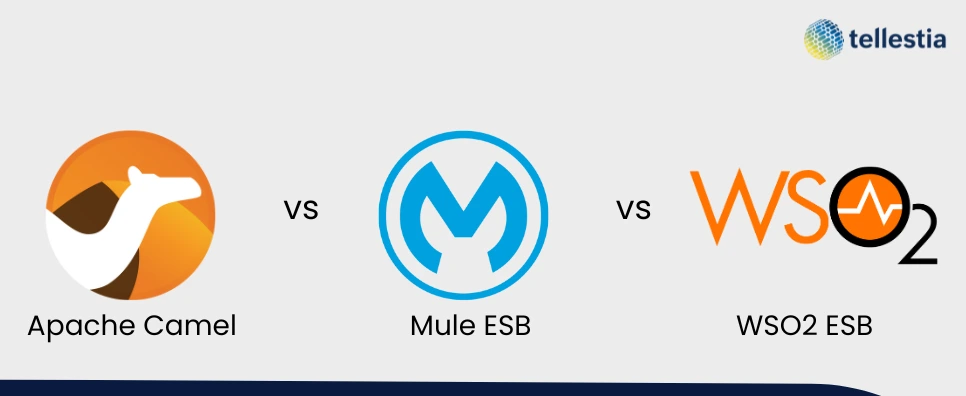
This blog provides a detailed and unbiased comparison of three widely adopted open-source integration platforms used by enterprises worldwide:
- Apache Camel
- Mule ESB (Community Edition)
- WSO2 Integrator
The objective is not to promote a single tool blindly, but to help enterprise decision-makers understand where each platform fits, what trade-offs exist, and how to choose the right integration foundation for their organization.
Understanding Modern Enterprise Integration Challenges
Today’s enterprises operate in increasingly complex digital ecosystems. Most organizations must simultaneously manage:
- On-premises systems alongside cloud and SaaS applications
- API-driven partner ecosystems
- Microservices and event-driven architectures
- Real-time data exchange and batch processing
- Security, governance, and compliance across integrations
Traditional point-to-point integrations create technical debt, increase maintenance overhead, and become fragile as systems scale. This is where integration platforms play a critical role by centralizing connectivity, enforcing patterns, and improving operational visibility.
Why Enterprises Are Moving Toward Open Source Integration
Open-source integration platforms have fundamentally changed how enterprises approach system connectivity. Unlike proprietary solutions that charge per connector, per runtime, or based on data throughput, open-source platforms offer transparency, architectural freedom, and community-driven innovation.
Key reasons enterprises consider open source integration include:
- Lower total cost of ownership
- No forced vendor lock-in
- Flexibility to customize and extend integration logic
- Support for industry-standard Enterprise Integration Patterns
- Freedom to deploy on-premises, cloud, or hybrid environments
As integration becomes a long-term strategic capability rather than a short-term IT project, these advantages become increasingly important.
Apache Camel: The Lightweight Integration Framework
Apache Camel is a well-established open-source integration framework maintained by the Apache Software Foundation. It is widely used by development teams that prefer a code-first approach and want maximum control over integration logic.
Key Strengths of Apache Camel
Apache Camel ships with more than 300 components that enable integration with databases, messaging systems, file systems, APIs, and cloud services. It supports approximately 50 data formats, including standards commonly used in finance, healthcare, and telecommunications.
Camel uses Enterprise Integration Patterns as its foundation and allows developers to define routes using domain-specific languages in Java, XML, Groovy, and YAML. Its seamless integration with Spring Boot and Quarkus makes it a popular choice for microservices-based architectures.
Where Apache Camel Excels
Apache Camel is an excellent fit for organizations that:
- Have strong Java development expertise
- Want to embed integration logic directly into applications
- Prefer lightweight deployments with minimal runtime overhead
- Need fine-grained control over routing and transformations
The framework’s flexibility and performance make it well suited for cloud-native and containerized environments.
Limitations to Consider
Apache Camel requires hands-on development effort. Non-developers and business users cannot easily build or maintain integrations without Java knowledge. It also lacks built-in enterprise capabilities such as centralized monitoring, governance, and lifecycle management.
While Camel itself is free, enterprises must account for development costs, operational tooling, and long-term maintenance effort as integration complexity grows.
Mule ESB is one of the most widely adopted integration technologies globally. It is backed by MuleSoft and is commonly used by large enterprises across industries such as banking, retail, manufacturing, and logistics.
Core Capabilities
Mule ESB provides:
- Over 200 pre-built connectors for popular enterprise systems
- API-led connectivity to promote reuse and modular integration
- Visual integration development through Anypoint Studio
- Enterprise-grade security, monitoring, and management
Its unified platform approach makes it attractive for organizations that want a single vendor-managed integration stack.
Where Mule Performs Well
Mule is particularly suitable for enterprises that:
- Prefer visual and low-code integration development
- Require a mature ecosystem of connectors
- Want centralized monitoring and lifecycle management
- Are comfortable with a subscription pricing model
Its long track record provides confidence in stability and scalability.
Cost and Vendor Dependency Considerations
Although Mule offers an open-source core, most enterprise capabilities are delivered through the Anypoint Platform, which follows a subscription-based licensing model. Costs typically increase based on environments, throughput, and runtime usage.
For many organizations, this results in high long-term operational costs and a strong dependency on the MuleSoft ecosystem, which can limit architectural flexibility over time.
WSO2 Integrator represents a different approach to open-source integration. It provides enterprise-grade capabilities while remaining completely open source, including features that are often proprietary in competing platforms.
Founded in 2005, WSO2 has grown into the largest open-source integration vendor by customer adoption and revenue, supporting enterprises across banking, telecom, healthcare, retail, and the public sector.
What Sets WSO2 Apart
WSO2 Integrator offers:
- More than 160 production-ready connectors
- Support for real-time, batch, and event-driven integrations
- Full compliance with Enterprise Integration Patterns
- Native support for REST, SOAP, GraphQL, gRPC, WebSockets, and modern protocols
- Zero licensing fees with optional enterprise support
This model allows organizations to adopt enterprise integration capabilities without long-term financial lock-in. It supports both centralized ESB models and decentralized microservices-based integration, enabling gradual modernization rather than forced architectural shifts.
AI-Native Integration Development with WSO2
A key differentiator for WSO2 is its AI-native development experience.
With the Ballerina Integrator and VS Code tooling, developers benefit from:
- AI-assisted integration flow creation
- Automated data mapping and schema generation
- Intelligent document processing for unstructured data
- Automated test case generation
These capabilities significantly reduce development effort and improve time to market, especially for data-intensive enterprise integrations.
Feature Comparison: Apache Camel vs Mule ESB vs WSO2 Integrator
| Feature |
Apache Camel |
Mule ESB |
WSO2 Integrator |
| Open Source Model |
Fully Open |
Partially Open |
Fully Open |
| Licensing Cost |
Free |
Subscription based |
Free |
| Pre-built Connectors |
Components based |
200+ |
160+ |
| AI-Assisted Development |
No |
Limited |
Native |
| Enterprise Governance |
Limited |
Strong |
Strong |
| Deployment Flexibility |
High |
Moderate |
Very High |
| Vendor Lock-in |
None |
Moderate |
None |
| Best Fit |
Developer-centric teams |
Large Enterprises |
Modern Enterprises |
The Role of Tellestia in Enterprise Integration
Choosing the right integration platform is only part of the equation. Successful enterprise integration depends on architecture design, implementation quality, governance, and long-term operational support.
Tellestia is an enterprise integration specialist with deep expertise across:
- Apache Camel-based microservices integration
- Mule ESB modernization and migration programs
- WSO2 enterprise integration, API management, and identity integration
Tellestia works with enterprises to design scalable integration architectures, execute complex migrations, and provide ongoing managed services across all three platforms.
Final Thoughts
Open-source integration platforms are no longer niche alternatives. They are strategic foundations for modern digital enterprises.
Apache Camel excels in developer-driven environments. Mule ESB offers maturity and tooling for large enterprises willing to accept subscription costs. WSO2 delivers enterprise-grade integration with complete openness, modern AI-assisted development, and superior cost economics.
With the right platform and the right integration partner, enterprises can transform integration from a technical necessity into a competitive advantage.
A. Subramaniam
Chief Technology Officer
Apache Camel
Enterprise Integration
Mule ESB
Open Source ESB
WSO2